


New Paragraph
Patient Safety & Quality Improvement Support
Supporting healthcare organisations to strengthen patient safety systems, learn from incidents, improve quality, and create safer healthcare environments through practical governance expertise.
Why Patient Safety Matters
Patient safety is at the heart of high-quality healthcare delivery. Advanced Clinical Solutions supports healthcare organisations to strengthen patient safety systems, improve organisational learning, develop effective governance frameworks, and embed sustainable quality improvement. Through practical healthcare expertise, we help organisations reduce risk, strengthen safety culture, and improve outcomes for patients and staff.
Healthcare organisations operate within increasingly complex environments where patient safety depends upon effective systems, strong leadership, continuous learning, and proactive governance. We help organisations move beyond compliance and develop practical approaches that strengthen safety, reduce risk, and support continuous improvement..
Common Patient Safety Challenges
Incident Reporting
Under-reporting, inconsistent investigation, and limited organisational learning.
Learning from Events
Difficulty identifying contributory factors and implementing sustainable improvements.
Governance Oversight
Limited visibility of patient safety risks and trends.
Quality Improvement
.Improvement activity lacking structure or measurable outcomes.
Safety Culture
Challenges encouraging openness, learning, and psychological safety.
Regulatory Expectations
Increasing expectations around patient safety governance and organisational learning.
Psychological Safety
Creating environments where staff feel safe to raise concerns, report incidents, and challenge unsafe practice.
Leadership & Culture
Strong patient safety performance relies upon visible leadership, compassionate accountability, and a culture that supports learning
Frequently Asked Questions
Practical answers to common questions about Patient Safety, PSIRF and improving culture.
What is patient safety?
Patient safety is the prevention of avoidable harm during the delivery of healthcare. It involves creating systems, processes, and cultures that reduce risk, support learning, and improve outcomes for patients, families, and staff.
Effective patient safety extends beyond compliance and focuses on understanding how people, processes, technology, and environments interact within healthcare services.
What is PSIRF?
The Patient Safety Incident Response Framework (PSIRF) is NHS England's approach to improving how organisations learn from patient safety incidents.
Rather than focusing solely on investigation, PSIRF encourages organisations to understand the factors that contribute to incidents, identify opportunities for learning, and implement meaningful improvements that strengthen patient safety systems.
How should healthcare organisations investigate incidents?
Effective incident investigation should focus on understanding what happened, why it happened, and how similar events can be prevented in the future.
Modern approaches move beyond individual blame and explore system factors such as communication, training, workload, processes, equipment, environment, leadership, and organisational culture.
What are the most common patient safety challenges facing healthcare organisations?
Common challenges include:
- Under-reporting of incidents
- Inconsistent investigations
- Limited organisational learning
- Weak governance oversight
- Workforce pressures
- Communication failures
- Lack of quality improvement capability
- Psychological safety concerns
- Increasing regulatory expectations
Addressing these challenges requires strong leadership, effective governance systems, and a commitment to continuous improvement.
What is the difference between patient safety and clinical governance?
Patient safety focuses on preventing harm and improving safety outcomes for patients.
Clinical governance provides the framework through which organisations maintain and improve the quality and safety of services.
Patient safety is therefore a key component of effective clinical governance.
How can organisations improve patient safety culture?
Improving patient safety culture requires visible leadership, open communication, psychological safety, effective incident reporting, and a commitment to organisational learning.
Staff should feel confident raising concerns, reporting incidents, and contributing to improvement without fear of blame.
A good place to start is a safety culture survey of your organisation.
What are human factors in healthcare?
Human factors examine how people interact with systems, processes, technology, and environments.
Understanding human factors helps organisations identify why errors occur, strengthen system design, improve communication, and reduce the risk of avoidable harm.
What is psychological safety and why does it matter?
Psychological safety refers to an environment where individuals feel able to speak up, ask questions, raise concerns, and report mistakes without fear of embarrassment or punishment.
Research consistently shows that organisations with stronger psychological safety often have stronger learning cultures and better patient safety outcomes.
How do audits support patient safety?
Clinical audits help organisations measure performance against standards, identify variation, and monitor improvement.
When combined with effective governance and quality improvement processes, audits provide valuable insight into patient safety risks and opportunities for improvement.
How can quality improvement improve patient safety?
Quality improvement provides structured methods to test changes, measure outcomes, and continuously improve services.
By focusing on systems and processes, organisations can reduce risk, improve reliability, and strengthen patient outcomes over time.
How can ACS support patient safety improvement?
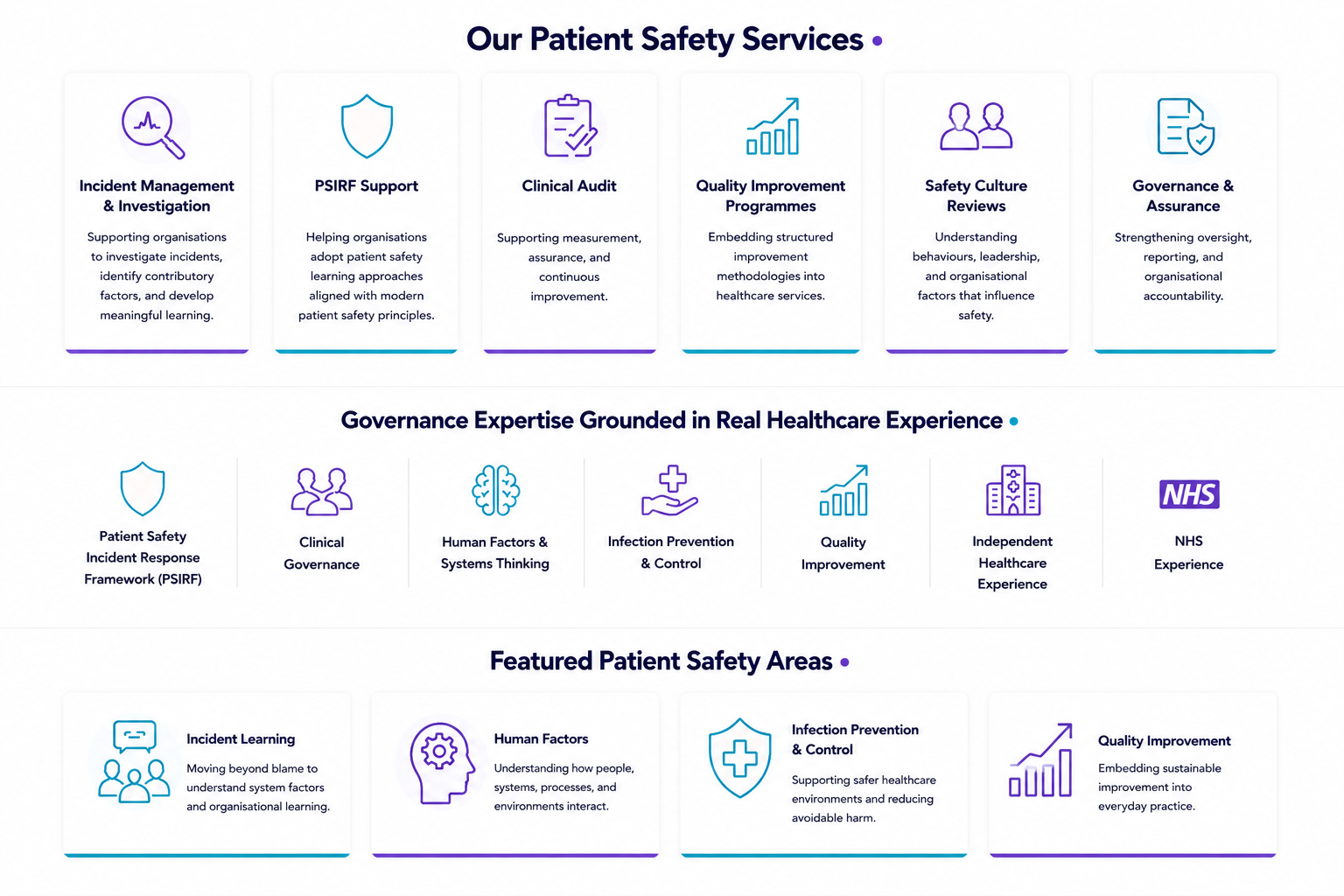
ACS supports healthcare organisations through patient safety reviews, governance assessments, incident learning, PSIRF support, quality improvement programmes, clinical audit, human factors approaches, and governance development.
Our focus is on practical, sustainable improvement that strengthens organisational confidence and supports safer healthcare delivery.